Integrative Healers Action Network

  • About
    • Our Story
    • Our Team
  • Volunteer
    • Volunteer Registration
    • Volunteer Resources
    • Volunteer Training Videos
  • Support
    • Donate
    • Funders
  • Firefighter Wellness
    • Detox Program >
      • Glutathione and ​Firefighter Health​
    • LA Firefighter Wellness Hub >
      • LA FIRES CLINICS
      • Detox Training Video
      • Supplements & Nebulized Glutathione
    • Mindfulness for Firefighters
  • Clinical Training for Firefighter Health
  • About
    • Our Story
    • Our Team
  • Volunteer
    • Volunteer Registration
    • Volunteer Resources
    • Volunteer Training Videos
  • Support
    • Donate
    • Funders
  • Firefighter Wellness
    • Detox Program >
      • Glutathione and ​Firefighter Health​
    • LA Firefighter Wellness Hub >
      • LA FIRES CLINICS
      • Detox Training Video
      • Supplements & Nebulized Glutathione
    • Mindfulness for Firefighters
  • Clinical Training for Firefighter Health

our story

On this page

Our Founding Story
Building the Infrastructure
Our History
Building the Model
Los Angeles
Where We Are Today

Our founding story

Born in a shelter,
out of necessity

In October 2017, a wildfire tore through Sonoma County with a speed and ferocity that caught the region off guard. The Tubbs Fire — then the most destructive wildfire in California history — displaced tens of thousands of people overnight and left entire neighborhoods in ash.

In the days that followed, Dr. Jen Riegle, ND, and Jenny Harrow-Keeler, colleagues at an integrative health clinic in Santa Rosa, drove to the evacuation shelters and first responder base camps. What they found was a profound gap in care — for the thousands displaced by the fires and for the first responders working in severe and extreme conditions on the front lines. Community members weren't seeking out the mental health support that was available — they were in too much shock to talk.

Integrative health and medicine focuses on the whole person — recognizing that trauma, stress, and toxic exposure don't just affect the mind, but show up throughout the body. Trouble sleeping, chronic pain, digestive issues, fatigue, a nervous system that won't settle — these are not separate problems. They are the body's response to what it has been through. True care addresses the connection between mind, body, and spirit.

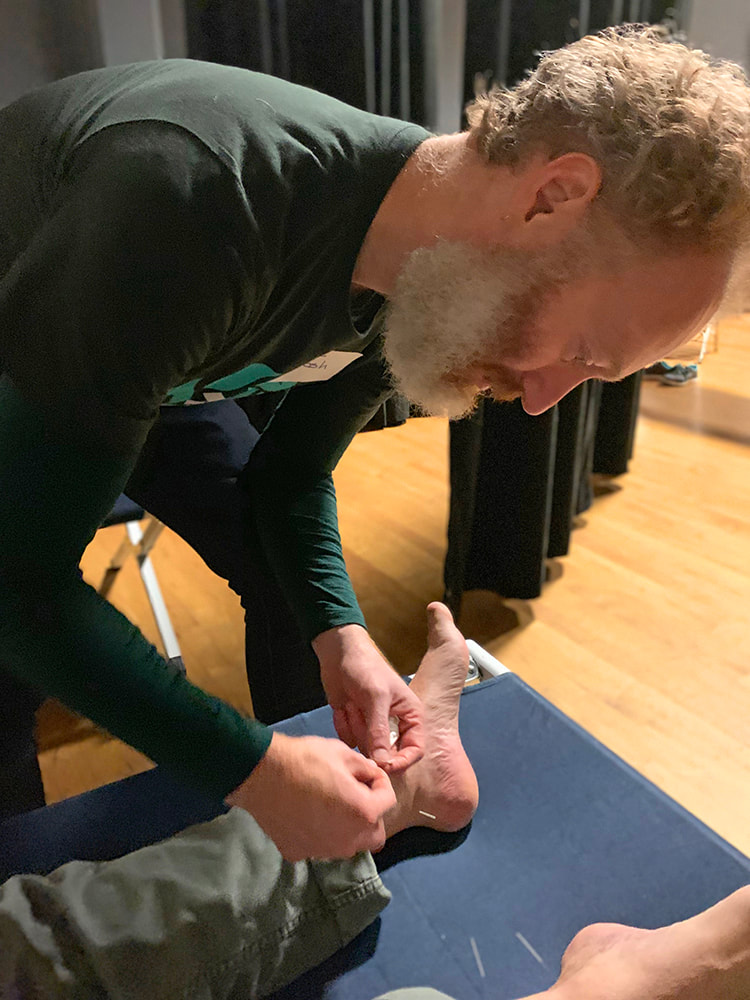
When trauma is acute, the body needs to be met first. Somatic and integrative therapies — like acupuncture and bodywork — work directly with the body to discharge the activation that trauma leaves in the nervous system. The body freezes what it cannot yet process. These therapies help the nervous system begin to complete that cycle — gradually moving from a state of overwhelm back toward regulation, safety, and presence. This is where trauma recovery begins.

Naturopathic medicine, with its specialty in environmental health, helps clear the toxic load of smoke, ash, and chemical exposure that accumulates in the body. Acupuncture, bodywork, naturopathic medicine, craniosacral therapy — these are just some of the modalities that make up an integrative approach to care — one that was virtually absent from disaster response before IHAN.

The difference was visible. A Red Cross shelter manager told IHAN's team that he had never seen a shelter so peaceful and content. People weren't just being housed — they were being cared for. Whole person care isn't a luxury. It is what people need most when everything has fallen apart.

None of that was available before IHAN showed up. The gap was enormous.

Integrative care isn't a luxury. In the aftermath of disaster, it is essential.

They started calling colleagues. Then friends of colleagues. Word spread fast. Within days, a grassroots movement had taken shape.

2,000+

practitioners mobilized through a grassroots Facebook group

15

clinics across evacuation shelters, base camps, healthcare settings, and National Guard armories

1,000s

of community members and first responders treated — entirely grassroots

That initial response caught the attention of the American Red Cross, which provided IHAN's first funding to continue delivering integrative support during disasters — an early validation that this model of care belonged in emergency response.

↑ Back to top

Building the infrastructure

From grassroots to professional

After the Tubbs Fire response, IHAN recognized that the scale and urgency of the need required more than goodwill — it required a professional, replicable system of care. We got to work building one.

How we built it

Practitioner verification

Every IHAN practitioner is verified as licensed or certified, and carrying active liability and malpractice insurance before deploying to a clinic. No exceptions.

Trauma-informed training

We developed trainings to equip all practitioners and volunteers — including clinic coordinators and admin support — with the skills to deliver care in disaster settings, including trauma-informed protocols specific to acute crisis response.

Community partnerships

We built relationships with professional organizations and community partners to sustain, grow, and professionalize the work — ensuring IHAN could show up reliably, deployment after deployment.

Key partners in building this work

Acupuncturists Without Borders, the California Naturopathic Doctors Association, and the American Red Cross were among our strongest early partners. The Red Cross granted IHAN access to set up clinics inside their shelters — a critical step in reaching the people who needed care most. Professional organizations like AWB and CNDA helped us build the networks, shared standards, and practitioner pipelines that made IHAN's model replicable and sustainable.

↑ Back to top
Picture

Our history

Five fires. Four years.
One growing movement.

From 2017 through 2020, IHAN responded to five major wildfire disasters across Northern California — delivering trauma-informed integrative care in the immediate aftermath and staying for long-term recovery.

2017

Tubbs Fire

Sonoma County

IHAN's founding response — 15 clinics across evacuation shelters, first responder base camps, healthcare settings, and National Guard armories. Over 1,200 clinic visits delivered in the weeks following the fire — the grassroots deployment that started it all.

15 clinics 150 volunteers 1,200+ visits

2017

Thomas Fire

Ventura County

IHAN's first deployment outside Sonoma County — an early sign that this model was needed beyond its home region.

1 clinic 20 volunteers 85 visits

2018

Camp Fire

Butte County, Paradise

California's deadliest wildfire leveled the town of Paradise almost entirely overnight. IHAN responded at evacuation centers in the aftermath — and then kept coming back. For years following the fire, IHAN brought practitioners from Sonoma County and the Bay Area to Butte County, a rural community with limited healthcare resources, to run long-term recovery clinics for survivors still rebuilding their lives and their health long after the national attention had moved on.

Multiple deployments Long-term recovery

2019

Kincade Fire

Sonoma County

When the Kincade Fire swept through Sonoma County, nearly 190,000 residents — almost half the county — were ordered to evacuate. IHAN was right there. The call to set up at evacuation shelters was immediate. Just two years after the Tubbs Fire, many of the same community members were once again displaced — still carrying unprocessed trauma from 2017, now facing it all over again.

6 clinics 27 volunteers 516 visits

2020

CZU Lightning Complex & Glass Fire

Santa Cruz & Sonoma Counties

Two fires, two counties — in the midst of a global pandemic. With COVID-19 reshaping how care could be delivered, IHAN adapted, running virtual clinics to support communities navigating the compounding stress and trauma of the pandemic alongside wildfire disaster. IHAN also responded in person to both fires, and in Santa Cruz County co-founded Colectivo CARE alongside Acupuncturists Without Borders and Livity Rising to provide ongoing support to Latinx farmworker communities.

3 clinics Virtual clinics Long-term recovery Colectivo CARE founded

With each response, the same gap appeared. Communities were being served — but firefighters, year after year, deployment after deployment, were absorbing a toxic load that had no dedicated care and no standard protocol. IHAN began building toward something more focused.

↑ Back to top

Building the model

Rooted in Sonoma County.
Built for California.

In the years that followed, IHAN turned its focus close to home — spending four years building and refining a specialized firefighter wellness program rooted in Sonoma County, running first responder wellness clinics at fire stations throughout the region and deepening relationships with local departments and fire leadership.

Central to this work is a close partnership with the Volunteer Fire Foundation (VFF). VFF is the essential bridge between IHAN and the fire service — building the relationships and trust that allow IHAN practitioners to show up at fire stations across California. VFF is not just a partner organization. They are woven into everything IHAN does with firefighters.

450+

firefighters served in first responder wellness clinics, 2021–2025

2,000+

treatments delivered across first responder wellness clinics

73

firefighters have completed the detox pilot program across 5 rounds

Funded by fire departments and later by the Sonoma County Fire Chiefs Association, the detox program marked a turning point. Fire culture in Sonoma County was shifting. Chiefs were paying attention. Firefighters were showing up. The kind of care IHAN offered was no longer a novelty — it was becoming recognized as essential.

Detox program — preliminary results

What the data is showing

Pre, mid, and post urine toxicology testing is showing significant reductions across a broad range of toxicants. Each toxicology test provided data for 103 toxins — including 20 heavy metals, 38 environmental toxins such as pesticides, 24 mycotoxins, and 21 PFAS chemicals, often called "forever chemicals" for their persistence in the body. Participants are tested at the start of the program, halfway through, and at completion — allowing the team to track progress in real time.

Heavy metalsSignificant reduction in measured levels across 20 heavy metals tracked

Environmental toxins & mycotoxinsMeasurable reductions in pesticides, mold-related toxins, and other environmental toxicants

PFAS compoundsReduction in "forever chemicals" previously thought to persist indefinitely in the body

Reported wellbeingMeaningful improvements in energy, sleep, cognitive function, and overall health

IHAN is currently working with a research partner to verify and publish this data — bringing the same rigor to the evidence base that practitioners bring to the clinic floor.

"The best thing I've ever done for myself."

— Fire Chief Shepley Schroth-Cary, Gold Ridge Fire

"Everything has improved — I feel great, energy is high, sleep is good, all in all feeling a lot better than when I started."

— Firefighter, IHAN detox program participant

Fire culture was shifting. And IHAN was ready to scale.

↑ Back to top

Los Angeles — a turning point

The largest deployment
in IHAN's history.

When the Eaton and Palisades fires broke out in January 2025, IHAN knew it had to respond. The LA fires were among the most destructive in California history — and what IHAN's leadership team witnessed on the ground was unlike anything in eight years of deployment.

What the team found on the ground

The firefighters IHAN encountered in Los Angeles were presenting with symptoms that reflected extreme toxic exposure. Both the Palisades and Eaton fires burned through densely populated urban environments — residential, commercial, and industrial buildings — releasing a toxic soup of heavy metals, asbestos, lead, PFAS compounds, and chemicals from incinerated vehicles, electronics, and building materials into the air firefighters breathed for weeks.

Severe respiratory distressFirefighters first on the line — in the initial hours and days before containment — faced the most severe toxic exposure. Persistent coughs, smoke inhalation, and acute toxic burden sent some to the hospital within days.

Extreme toxic exposureHeavy metals, asbestos, lead, PFAS and chemicals from burning residential, commercial, and industrial buildings across both fire zones.

Neurological symptomsBrain fog, profound fatigue, and disrupted sleep from weeks of sustained toxic exposure and deployment stress.

Trauma and stressNervous systems pushed far beyond their limits after weeks on the front lines of one of California's most destructive disasters.

1,825

firefighters served across LA deployments

4,445

treatments delivered in Los Angeles

"

Since the Palisades Fire and my original testing, I've been treated with glutathione and other detox treatments. My recent toxicology results are now well within normal range, and I know it is from our treatments.

Jeff Brown

Fire Captain, LAFD Station 69 · Pacific Palisades

First on scene at the Palisades Fire. Began treatment with IHAN two weeks after the fire.

100+

new practitioners and volunteers joined IHAN's network through the LA deployment

20

LA firefighters enrolled in IHAN's 12-week detox program

IHAN initially deployed to the Rose Bowl first responder base camp — setting up integrative wellness clinics for exhausted, toxic-exposure-burdened firefighters in the acute phase of the disaster. This deployment was carried out in coordination with the Volunteer Fire Foundation and in partnership with Acupuncturists Without Borders.

The response was immediate and overwhelming. IHAN was invited back — into Pasadena Fire, Palisades LAFD Station 69, Long Beach Fire, and beyond.

New partnership

Through a new partnership with the Phase One Foundation, a cancer research foundation, IHAN secured funding to run a 12-week detox program for 20 Los Angeles area firefighters — bringing the Sonoma County model to some of the largest fire departments in the country.

What had been a regional program became a statewide mission.

↑ Back to top
```

Where we are today

Three interconnected programs,
one statewide mission

IHAN now operates across California, meeting firefighters where they are — during active disasters, in the weeks and months that follow, and through structured long-term recovery.

Acute response

Base camp clinics

Integrative wellness clinics deployed to base camps during active fire disasters — immediate hands-on care for firefighters on the front lines.

Post-acute & long-term recovery

Fire station clinics

Ongoing clinics at fire stations in the weeks and months following a disaster — addressing the invisible toll that lingers long after the fire is out.

The detox program

Structured multi-week protocol

A structured multi-week program supporting firefighters through environmental health recovery — addressing toxic exposure, nervous system strain, and cumulative physical impact.

Launched April 2026: IHAN's first clinical training program — equipping integrative health practitioners across California with the specialized skills to serve firefighters using our detox protocol.

↑ Back to top

Find Us

432 Aviation Blvd.
Santa Rosa, CA 95403‪

Volunteer

Register
​Resources
Training Videos
​
Volunteer Login

About IHAN

Our Story
​Modalities
Blog
​Contact

Follow us

Subscribe
Diversity, Equity & Inclusion Statement  |  Privacy Policy   |   Terms & Conditions
Integrative Health Action Network is a project of Inquiring Systems, Inc., a registered 501(c)(3) non-profit organization (EIN 94-2524840) in good standing with the IRS. All donations to IHAN via Inquiring Systems, Inc. are tax-deductible to the fullest extent of the law.
Copyright © 2026 Integrative Healers Action Network. All Rights Reserved.
a lemonstrike creation.